
Beginning with Asset management services for institutions, the narrative unfolds in a compelling and distinctive manner, drawing readers into a story that promises to be both engaging and uniquely memorable.
In today’s dynamic financial landscape, institutions face the crucial task of effectively managing their assets to ensure growth and sustainability. Asset management services play a pivotal role in providing tailored strategies to optimize investments and mitigate risks, making them an indispensable partner for institutional success. This comprehensive guide delves into the nuances of asset management services for institutions, shedding light on key strategies, allocation techniques, risk management practices, and more.
Overview of Asset Management Services for Institutions
Asset management services play a crucial role in helping institutions effectively manage their investments and assets. These services are designed to optimize financial resources, minimize risks, and ensure long-term growth and sustainability.
Importance of Asset Management Services
- Asset management services help institutions make informed decisions regarding their investments, ensuring a diversified portfolio that aligns with their financial goals.
- These services provide professional expertise and strategic guidance to navigate the complex financial markets and maximize returns on investments.
- By outsourcing asset management to experts, institutions can focus on their core operations and strategic initiatives without the burden of day-to-day investment management.
Key Benefits of Asset Management Services
- Improved Risk Management: Asset management services help institutions identify and mitigate potential risks associated with their investments, minimizing losses and safeguarding assets.
- Enhanced Portfolio Performance: Through active monitoring and adjustment of investment portfolios, asset management services aim to optimize returns and achieve financial objectives.
- Cost Efficiency: By leveraging economies of scale and expertise, asset management services can lower investment costs and improve overall cost-effectiveness for institutions.
Role of Asset Management Services in Optimizing Institutional Investments
- Asset management services utilize data-driven strategies and market analysis to tailor investment solutions that align with an institution’s risk tolerance and objectives.
- These services help institutions adapt to changing market conditions, regulatory requirements, and economic trends, ensuring a proactive approach to investment management.
- Through continuous performance monitoring and evaluation, asset management services aim to enhance investment efficiency and drive sustainable growth for institutions.
Asset Management Strategies for Institutions
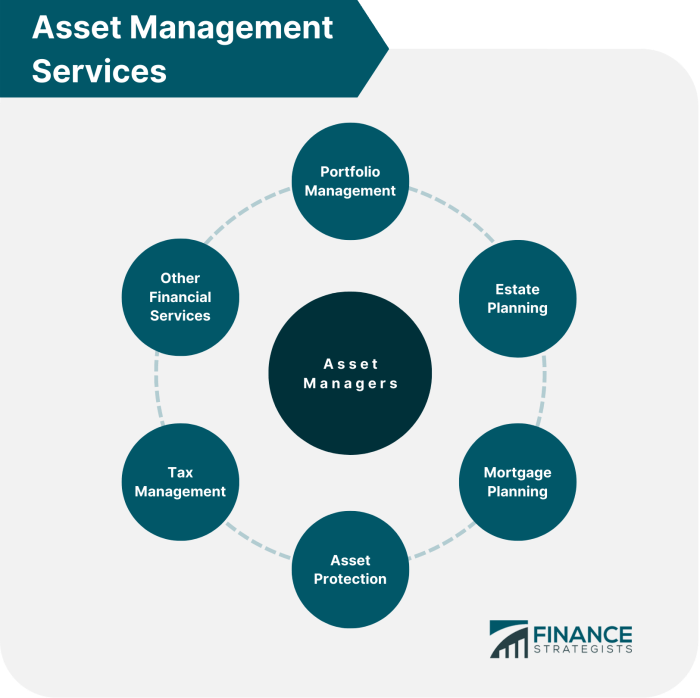
Asset management strategies for institutions play a crucial role in optimizing their financial resources and achieving their investment objectives. In this section, we will explore different asset management strategies commonly employed by institutions, compare active vs. passive asset management approaches, and provide examples of successful asset management strategies implemented by leading institutions.
Different Asset Management Strategies
Asset management strategies can vary based on the goals and risk tolerance of the institution. Some common asset management strategies include:
- Diversification: Spreading investments across different asset classes to reduce risk.
- Asset Allocation: Determining the optimal mix of assets based on the institution’s investment objectives.
- Risk Management: Implementing strategies to mitigate potential risks and protect the institution’s assets.
Active vs. Passive Asset Management
Active asset management involves frequent buying and selling of assets in an attempt to outperform the market, while passive asset management aims to replicate the performance of a specific market index. Key differences between the two approaches include:
- Active Management: Requires continuous monitoring and decision-making, potentially leading to higher fees and taxes.
- Passive Management: Involves lower costs and less frequent trading, but may not outperform the market in the long run.
Examples of Successful Asset Management Strategies
Leading institutions have successfully implemented various asset management strategies to achieve their financial goals. Some notable examples include:
- Harvard University Endowment Fund: Known for its diversified investment approach across different asset classes, helping to generate consistent returns over the years.
- BlackRock: Utilizes a combination of active and passive management strategies to cater to different client needs, resulting in strong performance across various market conditions.
- Vanguard Group: Pioneered low-cost index investing, providing investors with a cost-effective way to access diversified portfolios and achieve long-term growth.
Asset Allocation in Institutional Investing
Asset allocation is the process of dividing an investment portfolio among different asset classes such as stocks, bonds, real estate, and cash equivalents. This strategic approach is crucial in institutional investing as it helps organizations achieve their financial objectives while managing risks effectively.
Significance of Asset Allocation
Asset allocation plays a significant role in institutional investing by determining the overall risk and return profile of a portfolio. By diversifying investments across various asset classes, institutions can reduce the impact of market fluctuations on their overall performance. This helps in achieving a balance between risk and return based on the institution’s financial goals and risk tolerance.
- Asset allocation helps institutions manage risk by spreading investments across different asset classes that may react differently to market conditions.
- It enables institutions to capture opportunities for growth and income in various market environments.
- By aligning asset allocation with the institution’s investment objectives, time horizon, and risk tolerance, institutions can create a well-rounded portfolio.
Impact of Asset Allocation on Portfolio Performance
Asset allocation has a direct impact on the overall performance of an institutional investment portfolio. The right mix of asset classes can enhance returns while reducing volatility. Institutions need to regularly review and adjust their asset allocation strategy to adapt to changing market conditions and investment goals.
“The strategic allocation of assets is a key driver of long-term investment success for institutions.”
- Proper asset allocation can help institutions achieve their financial objectives while minimizing the impact of market downturns.
- Failure to maintain a well-balanced asset allocation can lead to suboptimal performance and increased exposure to risk.
- Asset allocation decisions should be based on thorough analysis, considering factors such as market trends, economic indicators, and investment outlook.
Asset Classes in Institutional Asset Allocation
Institutional investors typically consider a range of asset classes when allocating their investments. These asset classes include equities, fixed income securities, alternative investments, and cash equivalents. Each asset class has its unique characteristics and risk-return profile, allowing institutions to diversify their portfolios effectively.
- Equities: Represent ownership in a company and offer growth potential but also higher volatility.
- Fixed Income Securities: Include bonds and debt instruments that provide regular income and lower risk compared to equities.
- Alternative Investments: Include assets such as real estate, commodities, private equity, and hedge funds, offering diversification and non-correlated returns.
- Cash Equivalents: Include short-term, low-risk investments such as money market funds and treasury bills, providing liquidity and stability to a portfolio.
Risk Management in Asset Management Services
Risk management plays a crucial role in asset management for institutions as it involves identifying, assessing, and mitigating potential risks that could impact the institution’s investment portfolio. By effectively managing risks, institutions can protect their assets and optimize their investment returns.
Common Risk Management Techniques
- Asset Diversification: Diversifying investments across different asset classes, sectors, and regions can help reduce the impact of market volatility on the portfolio.
- Risk Assessment Models: Using quantitative models to assess and measure different types of risks, such as market risk, credit risk, and liquidity risk.
- Hedging Strategies: Employing hedging techniques, such as options and futures contracts, to protect the portfolio against adverse market movements.
- Stress Testing: Conducting stress tests to evaluate how the portfolio would perform under different adverse scenarios.
Importance of Diversification in Risk Management
Diversification is a key strategy in risk management for institutions as it helps spread risk across different assets, reducing the impact of any single investment on the overall portfolio. By investing in a variety of assets with low correlation, institutions can minimize the risk of significant losses during market downturns. Additionally, diversification can enhance returns by capturing opportunities in different market segments.
As institutions navigate the complex terrain of financial markets, the need for strategic asset management services becomes increasingly evident. By leveraging the insights and strategies Artikeld in this discussion, institutions can empower themselves to make informed decisions, maximize returns, and safeguard their financial future. With a focus on prudent asset allocation, risk management, and performance optimization, asset management services emerge as a cornerstone of institutional success in an ever-evolving economic landscape.
FAQ Corner
What are the primary benefits of asset management services for institutions?
Asset management services help institutions optimize their investments, mitigate risks, and enhance overall financial performance through tailored strategies and expert guidance.
How does asset allocation impact institutional investing?
Asset allocation is crucial in institutional investing as it determines the mix of various asset classes in a portfolio, directly influencing risk and return profiles.
What role does risk management play in asset management for institutions?
Risk management in asset management involves identifying, assessing, and mitigating risks to protect institutional assets and ensure long-term stability.


