
As Financial asset management services take the spotlight, this introduction invites readers into a world of financial expertise, offering a blend of knowledge and insight for a captivating read.
Exploring the various facets of financial asset management services, this passage sets the stage for a deep dive into optimizing financial portfolios.
Introduction to Financial Asset Management Services
Financial asset management services involve the professional management of various financial assets, such as stocks, bonds, and other investment instruments, to help individuals and businesses achieve their financial goals.
Effective financial asset management is crucial for individuals looking to grow their wealth, save for retirement, or plan for major life events. For businesses, proper asset management can help optimize cash flow, mitigate risks, and maximize returns on investments.
Examples of Financial Asset Management Services
- Investment Portfolio Management: Companies offer services to create and manage investment portfolios tailored to clients’ risk tolerance, financial goals, and investment preferences.
- Wealth Planning and Advisory: Financial advisors provide comprehensive wealth planning services, including retirement planning, estate planning, tax optimization, and investment strategies.
- Risk Management: Asset management firms offer risk assessment and mitigation strategies to protect clients’ assets from market volatility and unforeseen economic events.
- Financial Planning Tools: Some companies provide access to online platforms and tools that help individuals track their financial goals, monitor investments, and make informed decisions.
Types of Financial Asset Management Services
Financial asset management services encompass a variety of options tailored to meet the diverse needs of investors. Asset managers play a crucial role in providing these services by overseeing and optimizing the performance of their clients’ investment portfolios. Let’s explore some of the key types of financial asset management services and the benefits they offer:
1. Discretionary Asset Management
Discretionary asset management involves granting full authority to the asset manager to make investment decisions on behalf of the client. This type of service is ideal for investors who prefer a hands-off approach and want professionals to manage their investments actively. The benefits include personalized investment strategies, timely decision-making, and potentially higher returns due to expert guidance.
2. Non-Discretionary Asset Management
In non-discretionary asset management, the asset manager provides investment recommendations to the client, who ultimately makes the final decisions. This service is suitable for investors who want to stay involved in the decision-making process while still benefiting from professional advice. The key advantage is that clients retain control over their investment choices while leveraging the expertise of asset managers.
3. Wealth Management
Wealth management services cater to high-net-worth individuals and families, offering comprehensive financial planning and investment management. Asset managers work closely with clients to develop tailored strategies that align with their financial goals, risk tolerance, and legacy planning. The benefits of wealth management include personalized solutions, holistic financial guidance, and access to exclusive investment opportunities.
Asset Management Process
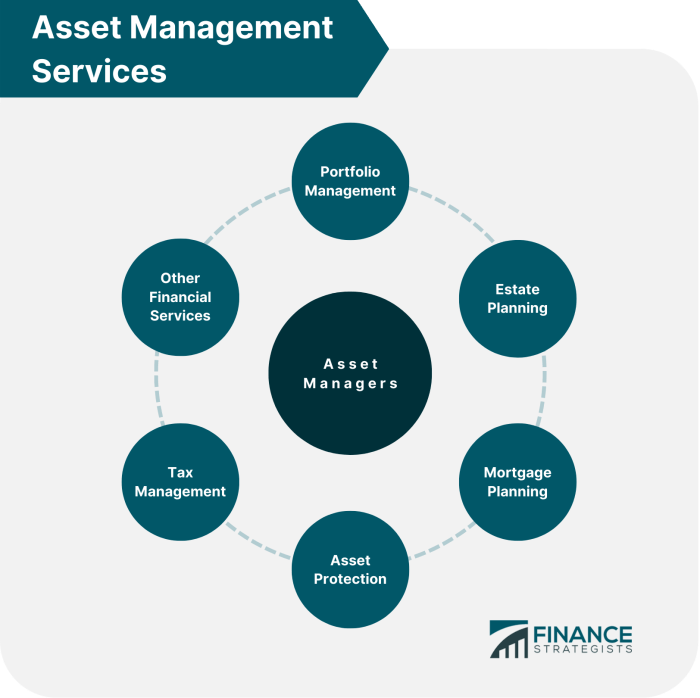
Effective management of financial assets involves a structured process that includes analyzing, monitoring, and adjusting investment portfolios to achieve financial goals and maximize returns.
Asset Analysis
Asset managers begin by conducting a detailed analysis of a client’s financial situation, risk tolerance, investment objectives, and time horizon. They assess the client’s current assets, liabilities, income, and expenses to develop a customized investment strategy.
- Utilizing financial models and tools to evaluate potential investment opportunities.
- Analyzing market trends, economic indicators, and company financials to make informed investment decisions.
- Assessing the risk-return profile of different asset classes to create a diversified portfolio.
Portfolio Monitoring and Adjustment
Once the investment portfolio is established, asset managers continuously monitor its performance to ensure it remains aligned with the client’s goals and risk tolerance.
- Regularly reviewing the portfolio’s asset allocation and rebalancing when necessary to maintain target levels.
- Monitoring market conditions and adjusting investments based on changing economic factors or market trends.
- Implementing risk management strategies to protect the portfolio from potential downturns.
Tools and Strategies
Asset managers utilize a variety of tools and strategies to effectively manage financial assets and optimize portfolio performance.
- Asset Allocation: Diversifying investments across different asset classes to manage risk and maximize returns.
- Financial Modeling: Using quantitative models to forecast investment outcomes and assess potential risks.
- Performance Attribution: Analyzing the performance of individual investments within the portfolio to identify sources of return.
- Tax-Efficient Investing: Implementing strategies to minimize tax liabilities and maximize after-tax returns.
Asset Allocation in Financial Asset Management
Asset allocation is a crucial concept in financial asset management that involves dividing an investment portfolio among different asset classes such as stocks, bonds, and cash equivalents. It is a strategic approach used by asset managers to optimize returns while managing risk.
Types of Asset Allocation Strategies
Asset managers utilize various asset allocation strategies to meet the investment objectives of their clients. Some common strategies include:
- Strategic Asset Allocation: This long-term approach involves setting target allocations for different asset classes based on the investor’s goals and risk tolerance.
- Tactical Asset Allocation: This more flexible approach allows asset managers to deviate from the strategic asset allocation based on short-term market conditions and opportunities.
- Dynamic Asset Allocation: This strategy involves actively adjusting the asset mix based on changing market conditions, economic outlook, and other factors.
Asset allocation helps in diversifying investment portfolios by spreading risk across different asset classes. By investing in a mix of assets with varying levels of risk and return potential, investors can reduce the impact of market fluctuations on their overall portfolio.
In conclusion, Financial asset management services play a crucial role in ensuring financial stability and growth, making informed decisions for a prosperous future.
Expert Answers
What are financial asset management services?
Financial asset management services involve managing various financial assets like stocks, bonds, and real estate to optimize returns.
How can asset allocation benefit my investment portfolio?
Asset allocation helps in diversifying your investments, reducing risk, and maximizing returns over the long term.


